
Acer Is on the Prowl: When Predator Joined Intel Arc
Originally published: 2022
Updated: 2026
Archive status: Recovered
Archive Note:
This article is based on recovered DigiDope source material from the recent DigiDope.Tech era. It has been updated in 2026 for clarity, formatting, and context while preserving the original topic and core conclusions.
When Acer revealed its first Arc-based graphics card, the announcement stood out immediately for one simple reason: Acer was not a company most PC enthusiasts expected to see entering the add-in GPU market at that moment.
The card in question was an Intel Arc A770 under Acer’s Predator branding, later known as the Predator BiFrost. At the time, the announcement was notable not just because it added another board partner to Intel’s first-generation Arc lineup, but because it suggested at least some manufacturers were willing to invest in Arc early, despite the uncertainty surrounding drivers, launch timing, and broader market reception.
There were very few details available in the initial reveal, but the images Acer shared gave away some interesting clues.
The first was the cooling design.
From the early product imagery, Acer’s card appeared to use a hybrid-style cooler layout that looked different from Intel’s own Limited Edition design. The GPU and memory section appeared to sit beneath a blower-style fan arrangement, while the power delivery hardware looked closer to a more traditional heatsink and fan setup. At the time, there was also speculation that the design might use some form of passthrough or blow-through cooling similar to approaches seen on certain Nvidia partner cards, although the early images were not clear enough to confirm that with certainty.
The second notable detail was power delivery.
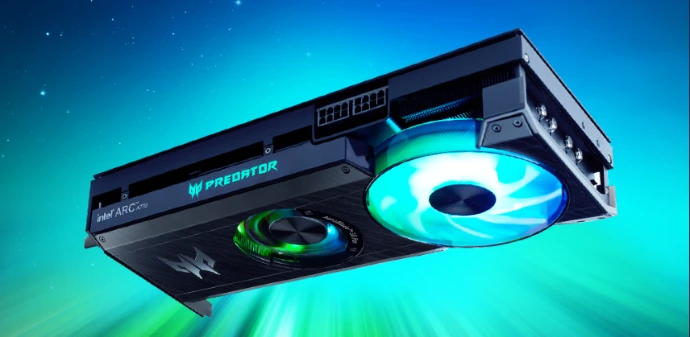
Acer Predator ARC A770
Two 8 Pin Power Connectors Visible
More overclocking headroom?
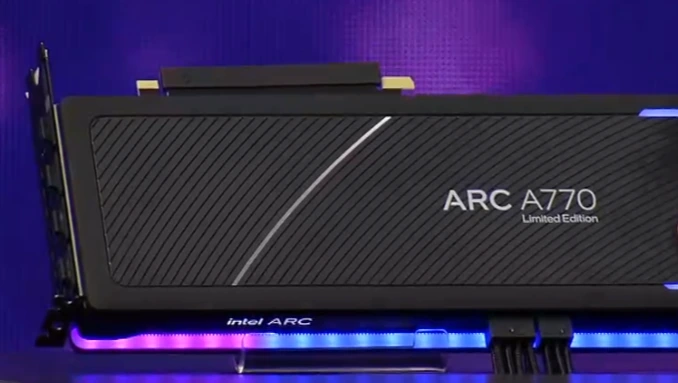
Intel ARC A770 LE
One 8 Pin Power, One Six Pin Power
Acer’s card appeared to use two 8-pin PCIe power connectors, whereas Intel’s own A770 Limited Edition had been shown with an 8-pin plus 6-pin configuration. That suggested Acer may have been aiming for more power headroom, whether for factory overclocking, board-level tuning, or simply a more aggressive partner implementation. At the time, that raised a reasonable question: if Acer was giving Arc more room to breathe than Intel’s own board, could partner cards end up being more interesting than the first-party reference-style design?
That question mattered because Intel Arc was already entering the market under unusual conditions.
Driver support for older game back catalogs was limited, platform requirements such as Resizable BAR made Arc less appealing for many users on older systems, and the value proposition depended heavily on whether Intel could compete aggressively enough on price. In that environment, a more distinctive partner card helped send a useful signal: Arc was not just an Intel-only experiment. Other manufacturers were beginning to shape their own versions of the product.
The original article also noted another issue that was easy to miss in the excitement surrounding a new product reveal: platform compatibility.
Arc’s dependence on Resizable BAR was an especially big deal in 2022 because value-focused buyers were often the very people most likely to be running older platforms. Intel officially positioned Arc around newer 10th Gen and 400-series systems on its own side, while AMD users generally needed Ryzen 3000-series or newer boards with SAM or ReBAR support. There was hope that older boards with BIOS updates might work, and at the time DigiDope was preparing to test exactly that on some updated Z370 hardware.
That concern remains one of the more interesting parts of this early Arc coverage in hindsight. It is easy to look back at launch-era GPU articles as simple announcement posts, but compatibility and platform requirements often matter just as much as performance. In Arc’s case, that was especially true.
Looking back, Acer’s entry into the Arc lineup mattered less because it transformed the market overnight and more because it showed Intel had at least some board-partner confidence behind the product. That confidence was important. Arc needed more than benchmark charts. It needed ecosystem support, retail presence, and visible buy-in from recognizable hardware brands.
Acer’s Predator BiFrost was one of the first signs that support might actually materialize.
Context (2026):
One reason this article is worth preserving is that early Arc coverage was not just about frame rates. Launch-day perception was shaped by partner support, board design, compatibility, and whether Intel could convince the market that Arc was more than a one-off experiment.
2026 Editor’s Note:
The most interesting part of this early piece is not the product reveal itself, but what it represented. Acer entering the Arc market gave Intel’s first-generation desktop GPU effort a little more legitimacy at a time when the entire platform still felt uncertain.
Related Reading:
- Intel Arc’s Strange Launch: Raiders of the Lost ARC
- The RTX 3060 8GB Problem: A Sheep in Wolf’s Clothing
- Modern DigiDope.Tech Arc A770 testing and follow-up coverage