
Radeon Bares Its Teeth: Revisiting the Radeon Monster Profile
Originally published: 2022
Updated: 2026
Archive status: Recovered
Archive Note:
This article is based on recovered DigiDope source material from the recent DigiDope.Tech era. It has been updated in 2026 for clarity, formatting, and context while preserving the original topic and core conclusions.
Why this article matters again in 2026
At the time, this was a quick reaction to an ambitious performance claim surrounding AMD’s RX 6800 XT and a new tuning tool from Yuri Bubliy, better known as 1usmus. In 2026, the topic has fresh relevance again for a simpler reason: we now have access to a Radeon RX 6800 XT and an RTX 3090, which creates the possibility of revisiting at least part of the original comparison ourselves.
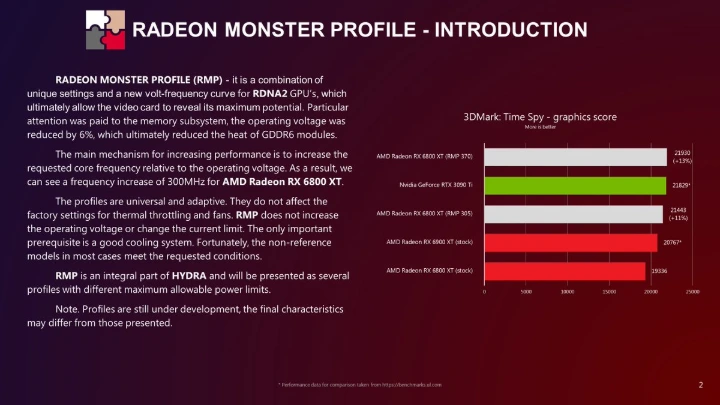
When 1usmus first teased what he called the Radeon Monster Profile, the headline claim was hard to ignore: an RX 6800 XT tuned with his profile edging past an RTX 3090 Ti in a custom 3DMark Time Spy run. That was the sort of claim guaranteed to get attention, especially coming from someone already known in enthusiast circles for CTR and AMD CPU tuning work.
The more interesting part, however, was not just the headline benchmark result.
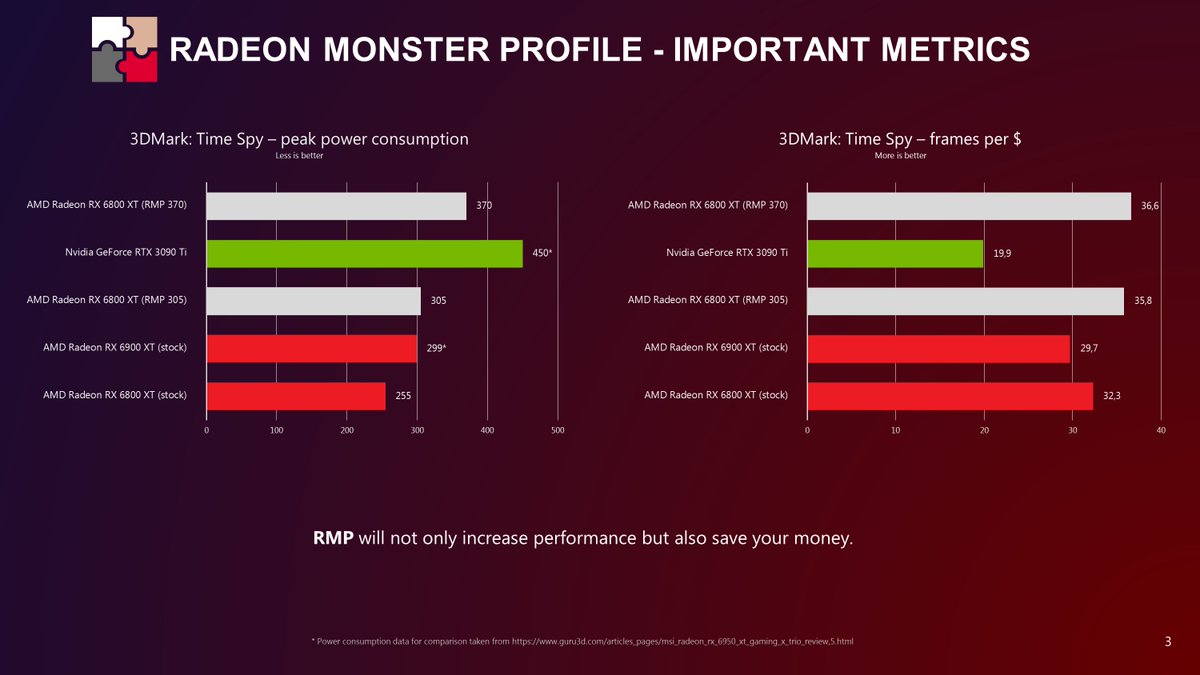
The slides showed the tuned 6800 XT drawing as much as 370 watts in its higher-power configuration, still below the 3090 Ti’s cited peak draw of 450 watts. More notably, the lower 305 watt profile appeared to slightly exceed the performance of a stock 6900 XT while operating at nearly the same power level. That raised a very practical enthusiast question: was this just benchmark theater, or was there actually meaningful untapped tuning headroom in RDNA2?
That was the real hook.
Radeon Monster Profile, or RMP, was presented as a set of tuning presets designed to extract more performance from RDNA2 GPUs by adjusting frequency behavior and voltage relationships. According to the material shared at the time, particular attention had been paid to the memory subsystem, while operating voltage was reduced to help manage GDDR6 temperatures. The overall pitch was simple: more performance, with careful tuning rather than brute-force overvolting.
That concept fit well with a broader trend in enthusiast hardware at the time. A great deal of the conversation around GPUs focused on stock-vs-stock comparisons, but many enthusiasts were increasingly interested in what happened after the factory settings were left behind. Undervolting, custom frequency curves, and power-limit tuning had become as interesting to some users as raw out-of-box results.
The original article noted something else worth preserving: the most compelling result may not have been the 370 watt profile at all.
The 305 watt tuning result was arguably the more interesting one, because it suggested the possibility of approaching or exceeding higher-tier stock performance without simply throwing enormous extra power at the card. That kind of result is often more useful to real users than a one-off “look what happens at maximum power” headline.
At the time, there was not much more to go on than the teaser slides and 1usmus’s public comments. He later confirmed that the tool was also expected to support the 6900 XT and 6950 XT, but the software itself had not yet reached the point where broader validation was possible. That made the original article necessarily brief and somewhat provisional. It was a news reaction, not a final verdict.
That is where RMP gains new life in 2026.
What was once just an interesting enthusiast claim can now be revisited with some actual hardware on hand. A modern retest would not perfectly recreate the original scenario, particularly if the exact software and profiles are no longer available in the same form, but it could answer a more useful question anyway:
How much performance headroom does the RX 6800 XT still have relative to a high-end Ampere card when tuned carefully rather than compared strictly at stock settings?
That question is worth asking.
It is also more in line with DigiDope’s current direction. Rather than simply repeating a dramatic slide deck claim, the smarter follow-up is to test the broader idea ourselves: what happens when a well-regarded RDNA2 card is pushed intelligently, and how close can it get to hardware from a higher price class or tier?
In that sense, the original article still works.
The teeth were not just in the benchmark score. They were in the suggestion that, with the right tuning, AMD’s RX 6800 XT might have had more fight in it than many stock comparisons implied.
Context (2026):
One reason older enthusiast news posts are worth revisiting is that many of the most interesting claims were never fully followed up on outside the moment. With suitable hardware now available, this is the kind of topic that can move from “interesting announcement” to “testable idea.”
2026 Editor’s Note:
The original version of this article was intentionally brief because the tool had only been teased, not fully validated. What makes it worth preserving now is the opportunity it creates for a proper follow-up: not whether every original slide should be taken at face value, but whether the underlying tuning argument still holds up when tested directly.
Related Reading:
- Intel Arc’s Strange Launch: Raiders of the Lost ARC
- The RTX 3060 8GB Problem: A Sheep in Wolf’s Clothing
- Future DigiDope.Tech RX 6800 XT vs RTX 3090 follow-up testing